
From Egg to Hatchling: Epaulette Sharks
Published March 18, 2026
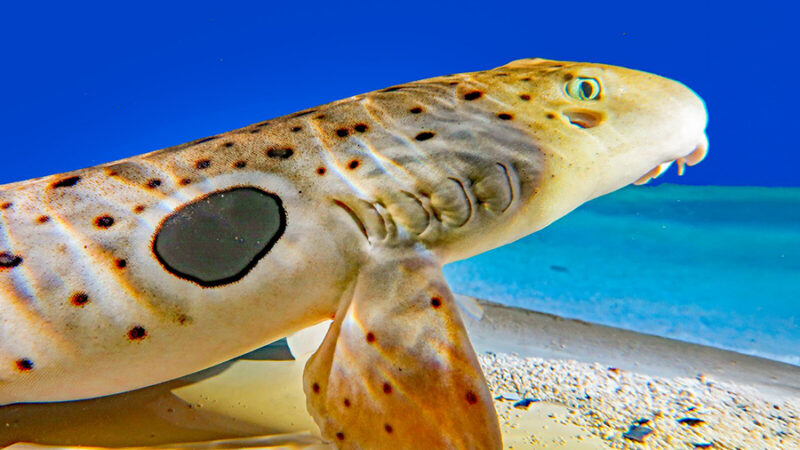
In the shallow coral reefs and tide pools of the western Pacific lives the remarkable epaulette shark, a small species known both for its ability to “walk” across the seafloor and for surviving in tide pools where oxygen levels can drop to extremes.
A Shark that Starts Life Inside a Mermaid’s Purse
An epaulette shark (Hemiscyllium ocellatum) begins its early life inside a leathery protective capsule known as a mermaid’s purse. These egg cases are tough, collagen‑based structures designed to endure shifting substrates and occasional turbulent water. Though durable, the casing remains permeable enough to allow oxygen and waste to diffuse between the embryo and surrounding seawater, an essential exchange for proper development.
Inside the egg case, the embryo draws nourishment from a large yolk sac and is cushioned by a jelly‑like substance that absorbs shock during the long incubation period. As development progresses, small slits form in the casing to improve water circulation. The developing shark actively fans its tail to move oxygenated water across its gills, an early behavior that prepares it for life in shallow, variable environments.
Life Begins in a Tide Pool Nursery
The environment in which epaulette sharks hatch influences their development from the very beginning. These sharks are exceptionally tolerant of low‑oxygen conditions and can temporarily shut down certain non‑essential brain functions to conserve energy, a rare ability among vertebrates. Studies suggest that this tolerance begins developing during the embryonic stage, allowing hatchlings to survive in tide pools that would be lethal to many other species.
Shallow nursery habitats also experience frequent temperature fluctuations. Research has shown that embryos raised in warmer waters may hatch sooner than those in cooler conditions, even though hatchlings tend to reach similar sizes later in life. Elevated incubation temperatures, however, can influence muscle fiber density and cellular development, offering insight into how environmental conditions, and a changing climate, may affect early growth and long‑term fitness.
Hatching Day: A Small Shark Enters the Reef
After roughly five months inside the egg case, the young shark is ready to emerge. Using rhythmic movements, it breaks open the casing and swims out into the reef, typically only a few inches long but already marked with distinctive spots and bands that help it camouflage against coral rubble and sand.
Aquariums that monitor these early stages have documented hundreds of successful hatchings. The New England Aquarium, for example, recently celebrated its 100th epaulette shark hatchling as part of a breeding program refined over decades. Juveniles often spend their first 12 to 18 months in specialized nursery habitats before transitioning into public exhibits or moving to partner institutions.
Built to “Walk” Before It Can Swim
One of the epaulette shark’s most famous traits is its ability to “walk” along the seafloor. Rather than relying solely on swimming, epaulettes use their muscular pectoral and pelvic fins to push themselves across coral rubble, sand flats, and even briefly exposed reef surfaces during low tide.
This walking behavior allows epaulette sharks to move between tide pools in search of food or refuge, giving them access to habitats that many other sharks cannot tolerate. Their flexible bodies and jointed fins make this movement surprisingly efficient, and researchers believe this adaptation evolved specifically to help them navigate shallow reef systems where water levels and oxygen availability change rapidly.
A Species Full of Surprises
Epaulette sharks continue to intrigue researchers with their reproductive capabilities. In rare cases, females have produced viable eggs without ever encountering a male — a phenomenon known as parthenogenesis. One notable instance occurred in 2023 at the Brookfield Zoo, where a female epaulette shark that had never shared a habitat with a male successfully hatched a healthy pup after five months of incubation.
While such events are uncommon, they highlight the remarkable biological flexibility and resilience of this species under unusual conditions.
Meet Epaulette Sharks at Wonders of Wildlife
Guests can see epaulette sharks up close at Wonders of Wildlife in our Shipwreck Reef Exhibit, a dynamic environment designed to showcase life in shallow coral ecosystems. This exhibit highlights species adapted to reef flats and coastal waters, offering visitors a chance to observe epaulette sharks as they rest, explore, and move along the seafloor using their distinctive walking motion.

Why Their Story Matters
The epaulette shark’s journey from egg case to reef walker reveals a species finely tuned to survive in dynamic, and sometimes harsh, environments. Understanding these early life stages helps scientists – and the public – better appreciate the relationship between habitat, development, and survival.
By supporting responsible aquarium care and conservation‑focused breeding programs, institutions like Wonders of Wildlife help ensure that future generations can continue learning from and connecting with this extraordinary reef‑dwelling shark.
News & Updates
Read the latest news & updates about Wonders of Wildlife.
Recent News & Stories
- From Egg to Hatchling: Epaulette Sharks
- Safeguarding Species for the Future: How Species Survival Plans Protect Wildlife
- Where Legends Come to Life: Mermaids Return to Wonders of Wildlife
- Celebrating the Life of Sampson
- Celebrating Service: Veterans Day at Wonders of Wildlife
- Conservation Starts with a Gift: Explore our Holiday Offers
- Commemorating the Life of Capella